


This section explains how you can remotely access and programme your Mobeye device, depending on how it is powered. It clarifies when the device is reachable, how battery saving affects communication, and which remote programming options are available to you. You will also learn why the Mobeye Portal is the recommended solution and what limitations apply when using a standalone, battery-operated unit.
Continuous Communication in External Power Mode
If a Mobeye device is connected to an external power supply via its power input, the communication module remains active continuously and the device stays in programme mode. In this state, you can send commands to the device at any time and request its status.
Battery Operation and Power Saving Behaviour
A battery-operated Mobeye device is designed to conserve power as much as possible. The communication module is one of the main consumers of energy and is therefore switched off for most of the time. It only activates to send alarm messages, alarm restore messages, low-battery warnings, and test messages. After completing the transmission and establishing a network connection, the communication module switches off again. As a result, the device cannot be reached at arbitrary moments.
Remote Programming via the Mobeye Internet Portal
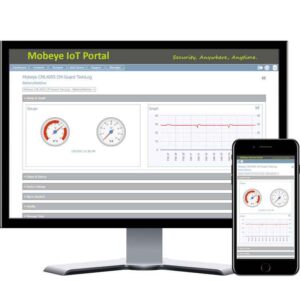
For remote programming, it is strongly recommended to use the Mobeye device in combination with the Mobeye Portal, which is the Internet of Things platform for Mobeye products. This portal provides additional functionality, including remote programming.
Configuration changes can be prepared in the portal at any time. The device sends test messages to the portal at regular intervals and, during these transmissions, it also retrieves any new settings. After this data synchronisation, the updated settings become active. This process applies to both battery-operated and externally powered devices. If the Mobeye unit is externally powered and the communication module is continuously active, the new settings can also be pushed to the device immediately.
Remote Programming of Standalone Battery-Operated Devices
If you want to remotely programme a standalone, battery-operated unit or check its status, the device must first be placed into programme mode by pressing the button on the unit. There is a remote method that may work, depending on the cellular network. When you send an SMS command to the device, the message may be held by the network while repeated delivery attempts are made. In some countries, these attempts can continue for several days. If the communication module connects during this period, the command may be received and the unit may respond. Some network providers retry delivery frequently enough that the module remains active long enough for the message to be delivered. To increase the chance of success, you must force the communication module to connect more often by configuring the device to send regular test messages. It is recommended to test this behaviour on your cellular network first. If the test is successful, you can remotely programme and query the battery-operated unit. However, this method is network-dependent and cannot be guaranteed to work in all situations.
Frequent Asked Questions on Remote Programming
Battery-operated Mobeye devices are designed to conserve power, so their communication module is off most of the time. This means the device cannot always be reached for remote programming or status checks. Use the Mobeye Portal or test messages to increase remote access success.
To remotely program or check the status of a Mobeye device, it must be in programme mode. For battery-operated units, press the button on the device to activate this mode. Programme mode allows the device to receive commands and respond to requests.
In some cellular networks, SMS commands are stored and retried until the device connects. If the GSM module activates during this period, the command may be delivered and processed. Success depends on your network provider and may vary by country.
No. SMS retry behaviour varies by cellular network. In some countries or networks, commands are delivered reliably, while in others, delivery may fail or take longer. Using the Mobeye Internet Portal is the most dependable solution.
The recommended solution is the Mobeye Portal. This IoT platform allows remote programming and configuration through scheduled data synchronisation, supporting both battery-operated and externally powered devices. It ensures reliable updates without depending on network-specific SMS delivery.