

The shift from analogue telephone lines to IP-based alarm reporting is already underway. In the Netherlands, analogue lines were phased out in 2023. In the United Kingdom, communications providers are replacing the underlying technology that supports fixed telephone networks, with the upgrade expected to be complete by January 2027.
For security installers and system owners, this has a direct consequence: alarm systems that rely on PSTN diallers to report to an Alarm Receiving Centre will need to be upgraded. IP reporting via 4G is the correct replacement — and the transition is more straightforward than it might appear.
What Is an Alarm Receiving Centre and Why Does IP Reporting Matter

An Alarm Receiving Centre (ARC) is a professionally staffed monitoring facility that operates around the clock. It receives alarm signals, validates them, and coordinates the appropriate response — whether that is contacting a keyholder, dispatching a response team, or alerting the emergency services.
The reliability of this process depends entirely on the communication path between the alarm system and the ARC. Analogue telephone lines provided that path for decades. IP reporting via 4G replaces it with a faster, more resilient connection that does not depend on a working landline.
One indicator of how seriously ARCs treat communication reliability is the mandatory 24-hour test report. If the expected daily test signal is not received, the ARC initiates checks immediately — because a missed test could indicate either a technical fault or a genuine security issue.
The SIA DC-09 Protocol
SIA DC-09 is the industry standard for IP alarm reporting. It defines how alarm data is formatted and transmitted between a device and an ARC, ensuring compatibility regardless of which manufacturer’s equipment is in use on either end.
When evaluating any IP alarm communicator for ARC reporting, SIA DC-09 compatibility is the baseline requirement. Without it, the device cannot communicate with a professional monitoring centre in a standardised way.
How Mobeye Handles IP Reporting to an ARC

The Mobeye CM4100 is designed specifically for this purpose. It connects to the alarm output of an existing system, monitors mains power, and communicates via LTE-M with 2G fallback — meaning it does not require a landline, broadband connection, or fixed infrastructure of any kind.
Alarm data is transmitted through the Mobeye Internet Portal, which forwards messages to the ARC in SIA DC-09 format. A daily test message is sent automatically, satisfying the ARC’s continuity monitoring requirement.
The CM4100 supports two input channels. Zone information from both is merged into a single clear message for efficient processing at the control room.
Private contacts — a keyholder, a property manager, or additional nominated receivers — can be added alongside the ARC. Both receive alerts simultaneously, with no conflict between the two notification paths.
What Is Not Forwarded to the ARC
It is important to understand the scope of what the CM4100 reports. Only alarm output messages are forwarded to the ARC. Tamper alerts and RF issues require separate consideration and are not included in the ARC reporting path. Discuss this with your ARC when setting up the account to ensure your monitoring arrangement covers all required signal types.
Setting Up ARC Reporting with the CM4100
The setup process involves six steps:
- Connect the CM4100 to the alarm output (relay) of the existing alarm system.
- Power the device with a 12V–24V supply or the supplied adapter.
- Register the CM4100 on the Mobeye Internet Portal using the included Mobeye SIM card.
- Provide Mobeye with the ARC details: the prom number, IP address and port numbers, and the required message codes.
- Mobeye completes the configuration and sends an initial test message to confirm the connection.
- Trigger a test alarm locally, confirm receipt with the control room, then remove the system from test mode.
On the ARC details in step 4: the prom number is your unique identifier at the ARC, assigned when you open an account. The IP address, port numbers, and message codes are provided by the ARC itself. You will need to contact your ARC to obtain these before Mobeye can complete the configuration.
Note that while the Mobeye SIM and portal service include ARC reporting at no additional charge, you must arrange your own account with an ARC independently.
Preparing for the Analogue Switch-Off
If you manage alarm systems that currently report via a PSTN dialler, now is the time to plan the upgrade. The January 2027 deadline in the UK is firm, and ARCs are already operating exclusively via IP in markets where the switch-off has occurred.
The CM4100 is a practical upgrade path: it connects to the existing alarm panel without replacing it, requires no new cabling or broadband connection, and is operational within a single site visit. For installers managing multiple sites, the same device can be configured remotely via the Mobeye Internet Portal.
For sites that do not currently have ARC monitoring but require it, the CM4100 provides a straightforward route to professional monitoring without a full system replacement. See the full alarm communicators range for related products.
Frequently Asked Questions
Contact ID is an older protocol originally developed for analogue telephone reporting. SIA DC-09 is its IP-based successor, designed for modern network communication. Most ARCs now require SIA DC-09 for IP reporting, though some accept both. Check with your ARC which protocol they require before specifying equipment.
No. The CM4100 includes a Mobeye SIM card. The portal service and ARC reporting are included — no separate data contract is required.
Yes. The Mobeye Internet Portal allows you to add private contacts alongside the ARC. Both receive alerts simultaneously when an alarm is triggered.
The CM4100 uses LTE-M as its primary connection with 2G as an automatic fallback. This dual-network approach reduces the risk of communication failure. The daily test message also serves as a continuous connectivity check — if the ARC does not receive it, they will initiate a fault investigation.
You will need the prom number, the ARC’s IP address and port numbers, and the message codes they use. These are provided by your ARC when you open a monitoring account.
Yes. It connects to the alarm output of an existing panel and operates independently of the panel’s own communication module. This makes it a practical upgrade for systems that currently report via PSTN without requiring a full panel replacement.
Recommended Product
-
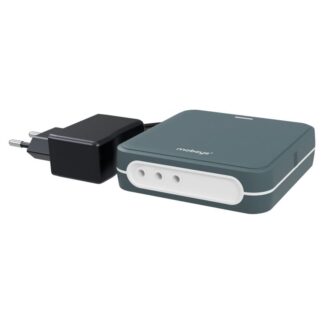
 Optional extra: Outdoor VersionMobeye PowerGuard CM4100 – 4G Power Failure AlarmPrice range: € 215,00 through € 220,00