


A remote temperature alarm can protect a well house, water pump, pressure tank and pipes from freezing, even when there is no Wi-Fi at the location.
Imagine a well house about 50 metres from your home. Inside are a water pump and pressure tank, and there is a heater to prevent freezing. You want to know if the temperature gets too low, but your Wi-Fi does not reach the building reliably.
You might already have a smart-home system using Wi-Fi, Zigbee or Z-Wave. Depending on the distance and construction of the buildings, you may be able to extend that network with a repeater. In other situations, a separate temperature monitoring system can be simpler.
A cellular temperature monitor does not need to connect to your home network. It uses the mobile network to send an alarm when the temperature falls below a set limit.
A simple setup for a remote well house
The basic idea is straightforward:
Temperature probe → cellular temperature monitor → mobile network → phone
The temperature sensor measures the temperature inside the well house, close to the pump, pressure tank or pipes you want to protect. The monitoring device checks the temperature against the configured alarm limit and sends an alert if it becomes too cold.
There is no need to get a Wi-Fi signal from the house to the well house. If mobile reception inside the building is weak, an external antenna can help. If the heater is powered from the mains, the power supply can also be monitored, giving you a warning if the heater loses power before the temperature has had time to fall significantly.
What makes remote buildings difficult to monitor?

The problem is often not the temperature sensor itself. It is getting a reliable connection between the sensor and the system that needs to receive the alarm.
Wi-Fi, Zigbee and Z-Wave are all commonly used for connecting sensors within homes and buildings. They can work very well when there is good coverage between the sensor and its hub or gateway. A detached building can make things more complicated because the signal may have to travel through exterior walls and across a sizeable distance.
Cinderblock walls, reinforced concrete, metal roofs and other building materials can also affect wireless communication. A repeater may solve the problem, depending on the distance, construction and network configuration. If extending the existing network is straightforward, there may be no reason to change it. If it becomes difficult, a cellular temperature monitor is another option.
How can you monitor temperature without Wi-Fi?
A cellular temperature monitor communicates directly over the mobile network rather than through your local Wi-Fi network. The remote building therefore does not need its own internet connection or a reliable connection to the router in your home.
This can be useful for well houses, pump rooms, detached garages, barns, agricultural buildings, holiday homes, storage buildings and technical rooms. The main thing to check is mobile coverage at the location. If the monitor can connect to a supported mobile network, it can send its alarm even though there is no Wi-Fi.
What if mobile reception is poor inside the well house?
A building that is difficult for Wi-Fi or other wireless signals can also be difficult for a cellular signal. Cinderblock walls, reinforced concrete and metal structures can reduce mobile reception, so the signal may be perfectly adequate outside but much weaker inside.
An external antenna can help in this situation. The monitoring device stays inside the building, while the antenna is installed where the mobile signal is better. The antenna and monitoring device are connected by a cable, allowing you to improve reception without moving the complete monitoring system outside.
This can be particularly useful in well houses, metal buildings, containers and other locations where the building itself makes radio communication more difficult.
What if the temperature needs to be measured somewhere else?
The monitoring device does not have to sit next to the point you want to measure. A temperature sensor with 10m cable (extendable to 20 metres, if desired) allows you to place the probe where the temperature matters most, while installing the monitoring unit somewhere more suitable for power and mobile reception.
In a well house, for example, the probe could be placed close to the pressure tank, pump or vulnerable water pipes. This can be useful when the best place to measure temperature is not the best place to install the monitoring device.
An extension cable and external antenna can also be used together. The probe is positioned where you want to measure temperature, while the antenna is positioned where it can get the best mobile reception.
Do not wait until the temperature reaches freezing
A freeze alarm does not have to be set at 0 °C. In many situations, you want to know that the temperature is falling before freezing actually becomes an immediate risk. This gives you time to check the heater, power supply, insulation or other possible causes.
The right alarm temperature depends on what you are protecting. For example, if a heater normally keeps a well house comfortably above freezing, a low-temperature alarm can warn you when the temperature starts to fall unexpectedly.
The Mobeye ThermoGuard supports configurable minimum and maximum temperature limits and adjustable alarm delays. The CM4200 can measure temperatures between -35 °C and +70 °C.
Monitor the heater as well as the temperature
A heater can fail without anyone noticing. The power can go off, a circuit breaker can trip, or the heater itself can stop working. If you only monitor the temperature, you will find out when the building starts getting cold. If you also monitor the heater’s power supply, you can be warned as soon as the power is lost.
The Mobeye ThermoGuard can monitor an external power supply as well as temperature. When the external supply fails, the device can send a power-failure alarm while its internal batteries keep the monitoring system running.
For a heated well house, this gives you two useful warnings: one when the heater loses power and another if the temperature subsequently becomes too low.
How do you receive a temperature alarm?
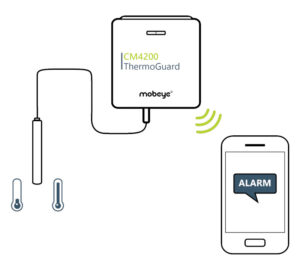
A temperature monitor is only useful if the alarm reaches someone who can respond. With a Mobeye ThermoGuard, alarms can be sent through the Mobeye App, telephone call, SMS and/or email.
You can also set up an escalation plan. For example, the first person receives the alarm and can acknowledge it. If the alarm is not acknowledged, the system can continue the escalation and call another contact. That can be useful when a remote building is unattended and a low temperature needs attention quickly.
Why monitor temperature over time?
Sometimes the first sign of a problem is not a single low-temperature reading but a pattern. Perhaps the temperature in the well house is getting lower every night, the heater is struggling during colder weather, or the temperature repeatedly approaches the alarm threshold without actually crossing it.
Temperature logging can make these patterns visible. The Mobeye ThermoGuard TwinLog CML4255 records temperature readings at configurable intervals and makes the data available through the Mobeye Portal. You can view the readings as graphs and tables and download the recorded data.
This can help you identify problems before they result in frozen pipes or damaged equipment. A temperature graph could, for example, reveal that a well house is consistently approaching the alarm threshold during cold nights, giving you an opportunity to improve insulation or heating before a freeze occurs.
Battery powered or mains powered?
A remote temperature monitor does not necessarily need mains power. Battery operation is useful where there is no convenient power supply. The monitor can operate independently and warn you when its battery level becomes low.
If mains power is available, external power has another advantage: the power supply can be monitored. For a well house with an electric heater, this can be particularly useful. The monitor can run from the external power supply while keeping its internal batteries as backup. If the mains power fails, the monitor can continue operating and send a power-failure alarm.
The best configuration depends on the location. A battery-powered installation may be ideal for a remote building without power, while a mains-powered installation with battery backup can provide additional protection where a heater or other equipment needs continuous power.
Is cellular monitoring better than Wi-Fi, Zigbee or Z-Wave?
Not necessarily. Wi-Fi, Zigbee and Z-Wave can all be excellent choices when they provide reliable coverage where the sensor is installed.
The advantage of cellular monitoring is different. The monitoring device has its own connection to the mobile network, so it does not depend on the local wireless network in the building. That can make sense when the monitored location is outside the reliable coverage of your existing network, when there is no Wi-Fi available or when you want the monitoring system to operate independently.
The right choice depends on the location and what you need to monitor.
Where else can remote temperature monitoring be used?
A well house is just one example. The same type of monitoring can be useful for pump rooms, detached buildings, agricultural buildings, vacant properties, holiday homes, refrigeration equipment, server rooms, technical installations and storage areas.
In each case, the basic requirement is similar: something important is located somewhere that is not continuously supervised, and you need to know if the temperature moves outside a safe range.
Remote temperature monitoring with Mobeye
Mobeye temperature monitoring systems are designed for locations where temperature needs to be monitored and alarms need to reach people remotely.
The Mobeye ThermoGuard CM4200 provides temperature alarms, power-failure monitoring when externally powered and two additional alarm inputs. It can operate on batteries or external power and can send alarms through the Mobeye App, telephone call, SMS and/or email.
For applications where temperature history is important, the Mobeye ThermoGuard TwinLog range adds temperature logging and access to historical data through the Mobeye Portal. The CML4255 supports one temperature sensor as standard, with a second sensor available.
-
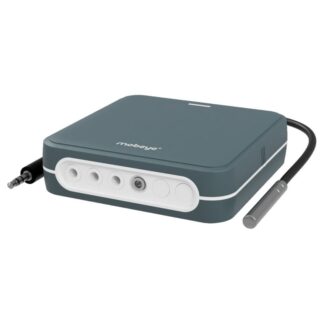
 Outdoor Enclosure (Add-on)
Mobeye ThermoGuard CM4200 – 4G Temperature Detector
Price range: € 269,83 through € 294,03 Choose options This product has multiple variants. The options may be chosen on the product page -
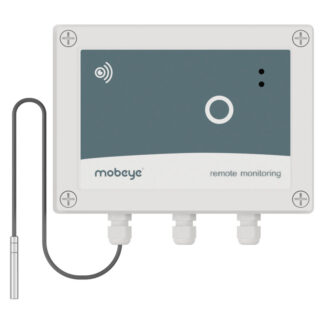
Mobeye Frost Alert CM4200X
€ 329,12 (€ 272,00 excl. VAT) Add to Basket -
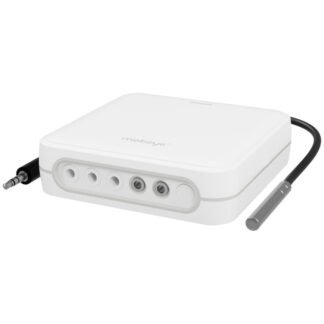
Mobeye ThermoGuard TwinLog CML4255 Temperature Alarm
€ 387,20 (€ 320,00 excl. VAT) Add to Basket -
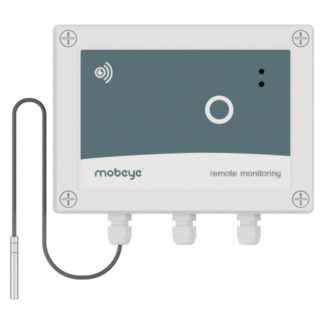
Mobeye ThermoGuard TwinLog CML4275 Temperature Monitor
€ 447,70 (€ 370,00 excl. VAT) Add to Basket
For installations where the mobile signal is weaker inside the building, an external antenna can be used with compatible Mobeye devices. A temperature sensor with an extension cable can also be used when the temperature needs to be measured away from the monitoring unit.
How to choose a remote temperature monitor
Start by looking at the location. If your existing Wi-Fi, Zigbee or Z-Wave network already reaches the building reliably, a compatible sensor may be all you need.
If it does not, consider whether extending the network with a repeater is practical. If you would rather not depend on the local network, cellular monitoring provides another option.
For a cellular system, check the mobile coverage at the location. If reception is weak inside, an external antenna may help.
Then decide where the temperature needs to be measured. If the monitoring unit cannot be installed at that exact point, an extended temperature sensor can give you more flexibility.
If a heater is protecting the building from freezing, consider monitoring its power supply as well as the temperature.
Finally, decide whether you only need an alarm or whether you also want temperature history. For simple freeze protection, an alarm may be enough. If you want to understand temperature trends or investigate recurring problems, temperature logging can be useful.
The best temperature monitoring system is the one that suits the actual building, the equipment you are protecting and the way you need to receive an alarm.
Frequently asked questions
Yes. A cellular temperature monitor can communicate directly over the mobile network, so the well house does not need its own Wi-Fi connection or access to the home’s router.
A temperature monitor with a low-temperature alarm can warn you before the temperature becomes dangerously low. If the building has a heater, monitoring the heater’s power supply as well can provide an earlier warning if it loses power.
A cellular temperature monitor is suitable for detached or remote buildings where Wi-Fi or a local smart-home hub is unavailable. The device communicates over the mobile network and can send alarm notifications remotely.
Yes. A temperature probe can be positioned near the pump, pressure tank or vulnerable pipes, while the monitoring device sends an alarm when the temperature falls below the configured limit.
An external cellular antenna can be used with compatible monitoring devices. The monitor remains inside while the antenna is positioned where the mobile signal is stronger.
Yes. A wired external temperature probe allows the monitoring device and the measurement point to be installed separately. This is useful when the temperature needs to be measured close to pipes, pumps or other equipment.
It does not need the local internet connection used by Wi-Fi sensors. The monitoring device communicates over the mobile network. The exact cellular technology and network availability depend on the device, SIM and location.
It depends on the installation. A smart-home sensor can be appropriate when the location already has reliable Wi-Fi, Zigbee or Z-Wave coverage. An independent cellular monitor is often more suitable when the location is remote, unattended or outside the range of the local network.
Yes, with a monitoring system that supports both functions. The Mobeye ThermoGuard can monitor temperature and an externally connected power supply, allowing you to receive an alert when the power fails as well as when the temperature becomes too high or too low.
Yes, with a Mobeye ThermoGuard TwinLog model. Temperature readings can be logged and viewed as historical data through the Mobeye Portal, making it possible to analyse temperature trends over time.
Browse related product categories: Temperature Monitoring – Power Failure Alarm – Shed Alarms